Posts

Showing posts with the label Neoclassicism

Nymph at the Fountain
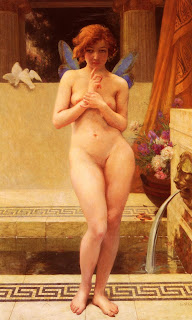
Image
Nymph at the Fountain Description: Nymph at the Fountain Français : Nymphe à la pièce d'eau Polski: Nimfa obok fontanny Date: before 1924 Author: Guillaume Seignac (1870–1924) http://commons.wikimedia.org/wiki/File:Seignac_Guillaume_Nymphe_A_La_Piece_D-Eau.jpg http://commons.wikimedia.org/wiki/User:Mattes/Favorite files/Images/B/Arts/Paintings/2 Guillaume Seignac | Female red hair in art | Paintings of nude standing females | Front views of females | Nude women with red hair | Neoclassicism (1750-1830)

L'Abandon (1924)

Image
L'Abandon (1924) Description: L'Abandon Date: before 1924 Author: Guillaume Seignac (1870–1924) Guillaume Seignac (1870 - 1924). Working during the last half of the 19th century, Guillaume Seignac typifies the French academic style which was preached by the Salon and l’Ecole des Beaux-Arts - where there was daily instruction in life drawing, anatomy, perspective and painting. During the end of the 19th century, Seignac was living in Paris at rue de Fleurus, 26 (moving to Boulevard du Montparnasse, 84 in 1902) and studied with Tony Robert-Fleury, Gabriel Ferrier and William A. Bouguereau; the latter, being one of the driving forces in the Salon at this time, was to have the greatest influence on him. http://commons.wikimedia.org/wiki/File:Guillaume_Seignac_-_L_Abandon.jpg Guillaume Seignac | Paintings of nude recumbent females (supine) | Neoclassicism (1750-1830)

Cupid and Psyche

Image
Cupid and Psyche English: Cupid and Psyche Français : Cupidon et Psyché Polski: Kupidyn i Psyche Author: Guillaume Seignac (1870–1924) Guillaume Seignac (1870-1924). Working during the last half of the 19th century, Guillaume Seignac typifies the French academic style which was preached by the Salon and l’Ecole des Beaux-Arts - where there was daily instruction in life drawing, anatomy, perspective and painting. During the end of the 19th century, Seignac was living in Paris at rue de Fleurus, 26 (moving to Boulevard du Montparnasse, 84 in 1902) and studied with Tony Robert-Fleury, Gabriel Ferrier and William A. Bouguereau; the latter, being one of the driving forces in the Salon at this time, was to have the greatest influence on him. http://commons.wikimedia.org/wiki/File:Seignac_Guillaume_Cupid_and_Psyche_Oil_On_Canvas.jpg http://www.allpaintings.org/v/Neoclassicism/Guillaume+Seignac/Guillaume+Seignac+-+Cupid+and+Psyche.jpg.html Neoclassicism (1750-1830)

Neoclassicism (1750-1830)

Image
Neoclassicism (1750-1830) The term Neoclassicism refers to the classical revival in European art, architecture, and interior design that lasted from the mid-eighteenth to the early nineteenth century. This period gave rebirth to the art of ancient Rome and Greece and the Renaissance as an opposition to the ostentatious Baroque and Rococo art that preceded the movement. Although the movement spread throughout Western Europe, France and England were the countries that used the style most frequently in their arts and architecture, using the classical elements to express ideas of nationalism, courage, and sacrifice. The movement was inspired by the discovery of ancient Italian artifacts at the ruins of Herculaneum and Pompeii. Neoclassicism emphasized rationality and the resurgence of tradition. Neoclassical artists incorporated classical styles and subjects, including columns, pediments, friezes, and other ornamental schemes in their work. They were inspired by the work of Homer and Plu...