Posts

Showing posts with the label Art movements

Post-Impressionism (1885-1905)

Image
Post-Impressionism (1885 - 1905) Post-Impressionism in Western painting, movement in France that represented both an extension of Impressionism and a rejection of that style's inherent limitations. The term Post-Impressionism was coined by the English art critic Roger Fry for the work of such late 19th-century painters as Paul Cézanne, Georges Seurat, Paul Gauguin, Vincent van Gogh, Henri de Toulouse-Lautrec, and others. All of these painters except van Gogh were French, and most of them began as Impressionists; each of them abandoned the style, however, to form his own highly personal art. Impressionism was based, in its strictest sense, on the objective recording of nature in terms of the fugitive effects of colour and light. The Post-Impressionists rejected this limited aim in favour of more ambitious expression, admitting their debt, however, to the pure, brilliant colours of Impressionism, its freedom from traditional subject matter, and its technique of defining form with s...
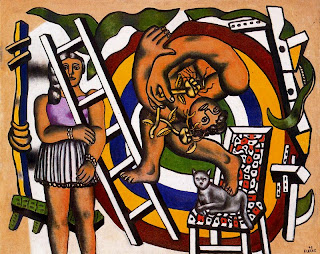
Cubism

Image
Cubism Cubism was one of the most influential visual art styles of the early twentieth century. It was created by Pablo Picasso (Spanish, 1881–1973) and Georges Braque (French, 1882–1963) in Paris between 1907 and 1914. The French art critic Louis Vauxcelles coined the term Cubism after seeing the landscapes Braque had painted in 1908 at L'Estaque in emulation of Cézanne. Vauxcelles called the geometric forms in the highly abstracted works "cubes." Other influences on early Cubism have been linked to Primitivism and non-Western sources. The stylization and distortion of Picasso's ground-breaking Les Demoiselles d'Avignon (Museum of Modern Art, New York), painted in 1907, came from African art. Picasso had first seen African art when, in May or June 1907, he visited the ethnographic museum in the Palais du Trocadéro in Paris. The Cubist painters rejected the inherited concept that art should copy nature, or that they should adopt the traditional techniques of p...

Symbolism (1880-1895)

Image
Symbolism (1880-1895) Symbolism began as a reaction to the literal representation of subjects preferring to create more suggestive and evocative works. It had its roots in literature with poets such as Baudelaire believing ideas and emotions could be conveyed not only through the meaning of words but also in their sound and rhythm. The styles of the Symbolist painters varied considerably, but they shared many of the same themes particularly a fascination with the mystical and the visionary. The erotic, the perverse, death and debauchery were also regular interests for the Symbolists. The leading figures of the movement included the two French men, Odilon Redon and Paul Gauguin, but Symbolism was not limited to France with other practitioners including the Norwegian Edvard Munch, the Austrian Gustav Klimt and the British Aubrey Beardsley. The movement also known as Synthetism flourished from around 1885 and continued until 1910. It was an important move away from the naturalism of the...

Aestheticism (1868-1901)

Image
Aestheticism English artistic movement of the late 19th century, dedicated to the doctrine of ‘art for art's sake’ – that is, art as a self-sufficient entity concerned solely with beauty and not with any moral or social purpose. It was a reaction to the Victorian sensibility, and dominated art and literature between 1868 and 1901. The artists of this movement believed that art was to be enjoyed for its own sake, rather than any moral message it might seem to contain. They emphasized aesthetic pleasure derived from the immediate experience of an art form, over any didactic value attached to it, or inadvertently extricated from it. The works of these aesthetes is characterized by sensuality and the profuse use of symbols and synaesthetic effects. The aim was to wholly engage the senses, and hold the beholder enthralled. Generally speaking, it represents the same tendencies that Symbolism or Decadence stood for in France, or Decadentismo stood for in Italy, and may be considered the...

Impressionism (1865-1885)

Image
Impressionism (1865 - 1885) The history of modern art begins with Impressionism, a movement founded in Paris as an opposition to the rigid traditions favored by institutions such as the Academie des Beaux-Arts. In 1863, Edouard Manet exhibited his painting Dejeuner sur l’herbe at the Salon des Refuses. The painting caused commotion, thus founding the Impressionist movement. Although Manet is the proclaimed leader and founder of the group, he was not present at the first group exhibition or any of the other eight collective Impressionist shows. The movement gained more attention in April of 1874 when a group of artists called Societe Anonyme des Artistes, Peintres, Sculpteurs, Graveurs began exhibiting outside of the official Salon. The same year, the term Impressionism was coined by criticizing journalist Louis Leroy, who worked for the magazine, Le Charivari. The Impressionist style of painting emphasized loose imagery rather than finely delineated pictures. The artists of the movem...

Pre-Raphaelite Brotherhood (1848-1854)

Image
Pre-Raphaelite Brotherhood (1848-1854) The Pre-Raphaelite Brotherhood (also known as the Pre-Raphaelites) was a group of English painters, poets, and critics, founded in 1848 by William Holman Hunt, John Everett Millais and Dante Gabriel Rossetti. The three founders were soon joined by William Michael Rossetti, James Collinson, Frederic George Stephens and Thomas Woolner to form a seven-member "brotherhood". The group's intention was to reform art by rejecting what they considered to be the mechanistic approach first adopted by the Mannerist artists who succeeded Raphael and Michelangelo. They believed that the Classical poses and elegant compositions of Raphael in particular had been a corrupting influence on the academic teaching of art. Hence the name "Pre-Raphaelite". In particular, they objected to the influence of Sir Joshua Reynolds, the founder of the English Royal Academy of Arts. They called him "Sir Sloshua", believing that his broad tec...

Hudson River School (1835-1870)

Image
Hudson River School America, 1835 to 1870. The Hudson River School was a mid-19th century American art movement embodied by a group of landscape painters whose aesthetic vision was influenced by romanticism. The paintings for which the movement is named depict the Hudson River Valley and the surrounding area, including the Catskill, Adirondack, and the White Mountains; eventually works by the second generation of artists associated with the school expanded to include other locales. Overview Neither the originator of the term Hudson River School nor its first published use has been fixed with certainty. The term is thought to have originated with the New York Tribune art critic Clarence Cook or the landscape painter Homer D. Martin. As originally used, the term was meant disparagingly, as the work so labeled had gone out of favor when the plein-air Barbizon School had came into vogue among American patrons and collectors. Hudson River School paintings reflect three themes of A...

Barbizon School (1830-1870)

Image
Barbizon School The Barbizon school (1830–1870) of painters is named after the village of Barbizon near Fontainebleau Forest, France, where the artists gathered. The Barbizon painters were part of a movement towards realism in art which arose in the context of the dominant Romantic Movement of the time. In 1824 the Salon de Paris exhibited works of John Constable. His rural scenes influenced some of the younger artists of the time, moving them to abandon formalism and to draw inspiration directly from nature. Natural scenes became the subjects of their paintings rather than mere backdrops to dramatic events. During the Revolutions of 1848 artists gathered at Barbizon to follow Constable's ideas, making nature the subject of their paintings. One of them, Jean-François Millet, extended the idea from landscape to figures — peasant figures, scenes of peasant life, and work in the fields. In The Gleaners (1857), Millet portrays three peasant women working at the harvest. There is no d...

Naturalism (1830- )

Naturalism Naturalism in art refers to the depiction of realistic objects in a natural setting. The Realism movement of the 19th century advocated naturalism in reaction to the stylized and idealized depictions of subjects in Romanticism, but many painters have adopted a similar approach over the centuries. One example of Naturalism is the artwork of American artist William Bliss Baker, whose landscape paintings are considered some of the best examples of the naturalist movement. Another example is the French Albert Charpin, from the Barbizon School,with his paintings of sheep in their natural settings. An important part of the naturalist movement was its Darwinian perspective of life and its view of the futility of man up against the forces of nature. Naturalism began in the early Renaissance, and developed itself further throughout the Renaissance, such as with the Florentine School. Naturalism is a type of art that pays attention to very accurate and precise details, and portr...

Victorian Classicism (1830- )

Image
Victorian Classicism Britain, Mid to Late 19th Century. Victorian Classicism was a British form of historical painting inspired by the art and architecture of Classical Greece and Rome. Although the word classical often implies direct inspiration from antique art, but this is not a necessary part of the concept, and according to context the word might be intended to convey little more than the idea of clarity of expression, or alternatively of conservatism. In the context of Greek art, the term `Classical' has a more precise meaning, referring to the period between the Archaic and Hellenistic periods, when Greek culture is thought to have attained its greatest splendor. The term `classic' is used to refer to the best or most representative example of its kind in any field or period. In the 19th century, an increasing number of Western Europeans made the Grand Tour to Mediterranean lands. There was a great popular interest in the region's lost civilizations and exotic cult...

Orientalism (1800-1900)

Image
Orientalism (1800 - 1900) Following the conquest of Egypt by France and the subsequent takeover by the British in late 18th century, Western Europeans found a new interest in the Near and Middle East. The Orientalist movement began when artists began painting their experiences as they traveled to countries such as Turkey, Persia, Iraq, Egypt, Lebanon, Palestine, Arabia, and North Africa. The movement lasted about a century and captivated many of the major artists of the 19th century, who created detailed and realistic paintings of their new subject matter. The Harem Bath (also known as A Bath, Woman Bathing Her Feet) by Jean-Léon Gérôme Pygmalion and Galatea 2 by Jean-Léon Gérôme Orientalism (1800-1900)

Romanticism (1800-1850)

Image
Romanticism (1800-1850) The Romantic Movement spread from art into literature and philosophy. It emphasized emotional, spontaneous and imaginative approaches. In the visual arts, Romanticism came to signify the departure from classical forms and an emphasis on emotional and spiritual themes. Caused by the sudden social changes that occurred during the French Revolution and the Napoleonic era, Romanticism was formed as a revolt against Neoclassicism and its emphasis on order, harmony, balance, idealization, and rationality. Romanticism began in Germany and England in the 1770’s, and had spread throughout Europe by the 1820’s. Not long after, its influence had spread overseas to the United States. The movement focused on imagination, emotion, and freedom by way of subjectivity and individualism. Artists believed in spontaneity, freedom from boundaries and rules, and living a solitary life free from societal boundaries. Romantic artists believed that imagination was superior to reason a...

Western Art

Image
Western Art When Shadows Hint Death by Charles Marion Russell (1864-1926) Western Art, American, XIX

Naïve Art (1780- )

Image
Naïve Art Naïve art is a classification of art that is often characterized by a childlike simplicity in its subject matter and technique. While many naïve artists appear, from their works, to have little or no formal art training, this is often not true. The term naïve art is often seen as outsider art which is without a formal (or little) training or degree. While this was true before the twentieth century, there are now academies for naïve art. Naïve art is now a fully recognized art genre, represented in art galleries worldwide. The characteristics of naïve art are an awkward relationship to the formal qualities of painting. Difficulties with drawing and perspective that result in a charmingly awkward and often refreshing vision, strong use of pattern, unrefined color, and simplicity rather than subtlety are all supposed markers of naïve art. It has, however, become such a popular and recognizable style that many examples could be called pseudo-naïve. Whereas naïve art ideal...

Neoclassicism (1750-1830)

Image
Neoclassicism (1750-1830) The term Neoclassicism refers to the classical revival in European art, architecture, and interior design that lasted from the mid-eighteenth to the early nineteenth century. This period gave rebirth to the art of ancient Rome and Greece and the Renaissance as an opposition to the ostentatious Baroque and Rococo art that preceded the movement. Although the movement spread throughout Western Europe, France and England were the countries that used the style most frequently in their arts and architecture, using the classical elements to express ideas of nationalism, courage, and sacrifice. The movement was inspired by the discovery of ancient Italian artifacts at the ruins of Herculaneum and Pompeii. Neoclassicism emphasized rationality and the resurgence of tradition. Neoclassical artists incorporated classical styles and subjects, including columns, pediments, friezes, and other ornamental schemes in their work. They were inspired by the work of Homer and Plu...

Rococo (1700-1760)

Image
Rococo (1700 - 1760) Based in France, Rococo was a decorative style most often used in interior design, painting, architecture, and sculpture. Normally associated with the reign of King Louis XV, the movement actually began in the 17th century. With the rise of the middle class, the death of Louis XIV at this time, the high society in Paris became the pinnacle of fashion. Louis XIV was succeed by the Duke of Orleans in 1715, who was know for enjoying the privileges of his office, moving social life away from the formal courts and into salons. This attitude was continued with the following reign of Louis XV. Rococo was manifested out of this new era of thought where society abandoned the formality of the earlier years and began pursuing personal amusement and happiness. One of the first Rococo painters was Jean-Antoine Watteau, whose work began to epitomize the movement with its idyllic and charming approach. Another artist that represented the Rococo period was Francois Boucher, who ...

Baroque (1600-1750)

Image
Baroque (1600 - 1750) Early Baroque art appeared in Italy in the late 16th century, while some countries such as Germany and colonial South America did not adopt the style until as late as the 18th century. It was the popular style during the Counter-Reformation in the 17th century. Some of its characteristics are evident in Dutch art, but it was mainly limited to Catholic countries. Not solely associated with religious art, the Baroque style can also be seen in other forms such as Dutch still-life paintings. At the beginning of the 17th century, the Baroque style spread from Rome and migrated to varying countries, evolving as artists fused it with the traditions of their native countries. Spain and Latin America added extravagance to the style, while other countries made it more conservative. The movement never gained popularity in Holland or England, but was successful in Flanders, supported by Peter Paul Rubens. In France, the Baroque style was favored by the monarchy and used in ...

Academic art (1563- )

Image
Academic art Academic art is a style of painting and sculpture produced under the influence of European academies or universities. Specifically, academic art is the art and artists influenced by the standards of the French Académie des beaux-arts, which practiced under the movements of Neoclassicism and Romanticism, and the art that followed these two movements in the attempt to synthesize both of their styles, and which is best reflected by the paintings of William-Adolphe Bouguereau, Suzor-Coté, Thomas Couture, and Hans Makart. In this context it is often called "academism", "academicism", "L'art pompier", and "eclecticism", and sometimes linked with "historicism" and "syncretism". The art influenced by academies and universities in general is also called "academic art". In this context as new styles are embraced by academics, the new styles come to be considered academic, thus what was at one time a rebe...

Mannerism (1520-1600)

Image
Mannerism (1520 - 1600) Mannerism was an art style that focused on the human form, depicted in intricate poses and in exaggerated, not always realistic settings. The term Mannerism was derived from the Italian word maniera, translated as “style.” It developed in Florence and Rome between 1520 and 1600, as a style that rejected the balance of the Renaissance period in favor of a more emotional and distorted point of view. This art style reflected the tension in Europe at the time of its popularity. The movement eventually gained favor in northern Italy and most of central and northern Europe. Paintings contained artificial color and unrealistic spatial proportions. Figures were often elongated and exaggerated, positioned in imaginative and complex poses. Works of the movement are often unsettling and strange, probably a result of the time period’s upheaval from the Reformation, the plague, and the sack of Rome. In 1600, Mannerists were accused of disrupting the unity of Renaissance cl...

Renaissance (1400-1600)

Image
Renaissance (1400-1600) Italy became a center of commerce between Europe and Eurasia, thus a Cultural Diffusion point between the Europeans and the Muslims. Also, Italy was home to many wealthy families, willing to finance education. The Medici family ruled Florence and advocated the arts and sciences. These aristocrats among others would pay people to learn and create for them, spreading knowledge into the lower classes. With this rebirth of intellect came the greater interest in Ancient Greek and Roman culture that inspired the revival of Classicism. The Italian Renaissance is divided into three major phases: Early, High, and Late Renaissance. The Early Renaissance was lead by sculptor Donatello, architect Filippo Brunelleschi, and painter Masaccio. They began the movement on the foundations that development and progress was integral to the evolution and survival of the arts. They found their inspiration form antiquity, creating realistic figures that portrayed personality and beha...