Cubism
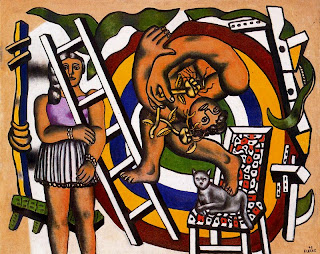
Cubism Cubism was one of the most influential visual art styles of the early twentieth century. It was created by Pablo Picasso (Spanish, 1881–1973) and Georges Braque (French, 1882–1963) in Paris between 1907 and 1914. The French art critic Louis Vauxcelles coined the term Cubism after seeing the landscapes Braque had painted in 1908 at L'Estaque in emulation of Cézanne. Vauxcelles called the geometric forms in the highly abstracted works "cubes." Other influences on early Cubism have been linked to Primitivism and non-Western sources. The stylization and distortion of Picasso's ground-breaking Les Demoiselles d'Avignon (Museum of Modern Art, New York), painted in 1907, came from African art. Picasso had first seen African art when, in May or June 1907, he visited the ethnographic museum in the Palais du Trocadéro in Paris. The Cubist painters rejected the inherited concept that art should copy nature, or that they should adopt the traditional techniques of p...