Posts

Works of Claude Monet (3)

Image
Works of Claude Monet (1840~1926) The Seine at Lavacourt The Church at Vetheuil The Headland of the Heve at Low Tide Vetheuil In Summer The Seine at Argenteuil The Seine at Bougival in the Evening Sun Setting Over the Seine at Lavacourt The Seine at Argenteuil The Seine at Port Villez Poplars on the Eote

Works of Claude Monet (2)

Image
Works of Claude Monet (1840~1926) The Boats Regatta at Argenteui La Grenouillere The Seine Estuary at Honfluer A Windmill Near Zaandam Tulip Fields With the Rijnsburg Windmill Beach at Honfleux The Sea at Fecamp Sailing at Sainte Adresse Rough Sea at Etretat La Porte D Amount Etretat

Works of Claude Monet (1)

Image
Works of Claude Monet (1840~1926) The Seine Below Rouen Beach at Sainte Adresse The Seine at Rouen Argenteuil The Red Boats Argenteuil Regatta at Argenteuil The Jetty at le Havre Bad Weather Argenteuil The Riverbank at Gennevilliers Sailing at Argenteuil

Claude Monet (1840-1926)

Image
Claude Monet (1840-1926) Birth name: Oscar Claude Monet Born: 14 November 1840 Paris, France Died: 5 December 1926 (aged 86), Giverny, France Nationality: French Field: Painter Movement: Impressionism Claude Monet (French pronunciation: [klod mɔnɛ]), born Oscar Claude Monet (14 November 1840 – 5 December 1926) was a founder of French impressionist painting, and the most consistent and prolific practitioner of the movement's philosophy of expressing one's perceptions before nature, especially as applied to plein-air landscape painting. The term Impressionism is derived from the title of his painting Impression, Sunrise (Impression, soleil levant). Early life Claude Monet was born on 14 November 1840 on the 5th floor of 45 rue Laffitte, in the ninth arrondissement of Paris. He was the second son of Claude Adolphe Monet and Louise Justine Aubrée Monet, both of them second-generation Parisians. On 20 May 1841, he was baptized in the local parish church, Notre-Dame-de-...

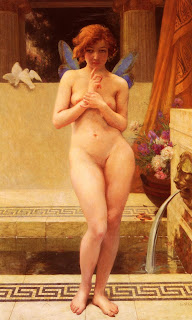
Nymph at the Fountain

Image
Nymph at the Fountain Description: Nymph at the Fountain Français : Nymphe à la pièce d'eau Polski: Nimfa obok fontanny Date: before 1924 Author: Guillaume Seignac (1870–1924) http://commons.wikimedia.org/wiki/File:Seignac_Guillaume_Nymphe_A_La_Piece_D-Eau.jpg http://commons.wikimedia.org/wiki/User:Mattes/Favorite files/Images/B/Arts/Paintings/2 Guillaume Seignac | Female red hair in art | Paintings of nude standing females | Front views of females | Nude women with red hair | Neoclassicism (1750-1830)

L'Abandon (1924)

Image
L'Abandon (1924) Description: L'Abandon Date: before 1924 Author: Guillaume Seignac (1870–1924) Guillaume Seignac (1870 - 1924). Working during the last half of the 19th century, Guillaume Seignac typifies the French academic style which was preached by the Salon and l’Ecole des Beaux-Arts - where there was daily instruction in life drawing, anatomy, perspective and painting. During the end of the 19th century, Seignac was living in Paris at rue de Fleurus, 26 (moving to Boulevard du Montparnasse, 84 in 1902) and studied with Tony Robert-Fleury, Gabriel Ferrier and William A. Bouguereau; the latter, being one of the driving forces in the Salon at this time, was to have the greatest influence on him. http://commons.wikimedia.org/wiki/File:Guillaume_Seignac_-_L_Abandon.jpg Guillaume Seignac | Paintings of nude recumbent females (supine) | Neoclassicism (1750-1830)

Cupid and Psyche

Image
Cupid and Psyche English: Cupid and Psyche Français : Cupidon et Psyché Polski: Kupidyn i Psyche Author: Guillaume Seignac (1870–1924) Guillaume Seignac (1870-1924). Working during the last half of the 19th century, Guillaume Seignac typifies the French academic style which was preached by the Salon and l’Ecole des Beaux-Arts - where there was daily instruction in life drawing, anatomy, perspective and painting. During the end of the 19th century, Seignac was living in Paris at rue de Fleurus, 26 (moving to Boulevard du Montparnasse, 84 in 1902) and studied with Tony Robert-Fleury, Gabriel Ferrier and William A. Bouguereau; the latter, being one of the driving forces in the Salon at this time, was to have the greatest influence on him. http://commons.wikimedia.org/wiki/File:Seignac_Guillaume_Cupid_and_Psyche_Oil_On_Canvas.jpg http://www.allpaintings.org/v/Neoclassicism/Guillaume+Seignac/Guillaume+Seignac+-+Cupid+and+Psyche.jpg.html Neoclassicism (1750-1830)